
How Corporates are killing the White collar work force.
Jacinto Fernandes
1/25/20254 min read
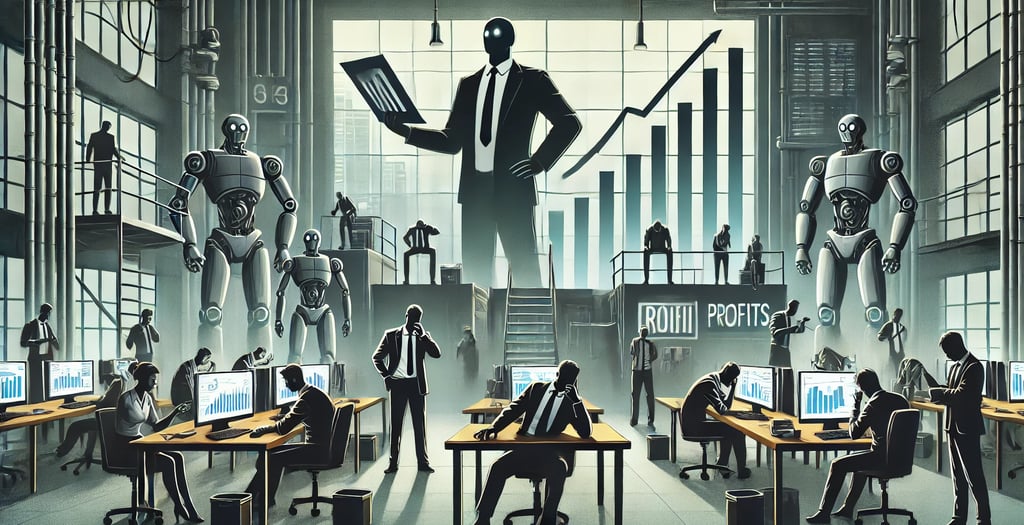

In the past few years, the business environment has experienced a drastic change, sometimes victimizing the professional workforce. That once-sought-after white-collar job, emblem of security and respectability, is rapidly turning into a source of burnout, disillusionment and career irrelevance. Although among technologys, globalization and competition markets are commonly presented as advances, it has led them to something where the focus of the business culture is profits rather than people. Corporates are chipping away at the white-collar workforce, gently but surely.
The Illusion of Job Security
Job security in the corporate world has become an outdated concept. Due to the advent of "at-will" employment and frequent reorganization, layoffs are commonplace. Employees who devote years to their organizations often find themselves replaced by cheaper alternatives or automated systems, with little acknowledgment of their contributions.
The gig economy has only exacerbated this trend. Firms are tending to rely more on freelancers and contractors to cut down costs and they can do without giving health insurance, retirement plan or paid leave, etc. This change has led to an environment of uncertainty and many workers are left to ask themselves if they will still have a job in the next 24 hours.
Overwork and Burnout
The corporate creed of "less is more" has created epidemic of overwork. Downsizing frequently leads to the same work being redistributed among a smaller number of personnel, with no increase in pay or even acknowledgement. This “work till you drop” culture prioritizes output over well-being, pushing employees to the brink of physical and mental exhaustion.
The glorification of hustle culture further compounds the problem. Workers' mental states are ones that would seem to encourage them to work late nights, to respond to emails while on holidays, and to give up their own personal time to "prove" themself to be "valuable. The long-term impact? A workforce plagued by anxiety, depression, and health problems.
Stagnant Wages and Inequality
In spite of increasing productivity, wages of white-collar workers have been flat. At the same time, income inequality has grown, as are the multimillion dollar salaries and bonuses of the executives and the minimum salary of the average worker who can't even meet the cost of living and the constant rise of living expenses.
In many instances promotions or increases are suspended or denied on the pretext of cost-savings. Performance-based rewards are presented as carrots, yet they are frequently attached to unattainable yardstick, which result in demotivation and undervalue of employees.
Automation and Job Redundancy
Automation and artificial intelligence (AI) are changing fields at an incredible pace, replacing professional occupations that were thought to be immutable. From data analysis to customer service, machines are increasingly performing tasks faster and more efficiently than humans. However, advancement of technology is unstoppable, but companies tend to focus on short-term success instead of upskilling their staff for change.
People are thrown to the wolves, trying to scramble to stay top of the heap in an industry where their jobs could be rendered obsolete in a single day. Compounding the problem is the dearth of investment in training and development which leads to a workforce feeling expendable and unimportant.
Toxic Workplace Cultures
A considerable number of corporates maintain a work environment which is deleterious to the health and well-being of their employees. Micromanagement, demanding tasks and lack of openness cause strain and mistrust. Office politics and favourism nevertheless stigmatise employees as well as alienating them, such that employees are now perceived as nothing more than some kind of machine part, in the unlikeliest of ways.
Emphasis on metrics and performance appraisals can reduce workers to the figures of a spreadsheet. This dehumanizing strategy breaks morale and commitment, resulting in high rates of attrition and the absence of commitment.
The Rise of "Quiet Quitting"
To address these challenges, a significant number of knowledge workers is experimenting with the practice of "quiet quitting" doing just enough to hold on to their jobs. This phenomenon highlights a growing disillusionment with the corporate system. Employees no longer feel there are beneficial reasons to do more than is required for employers who do not return the favour.
Although quiet quitting is sometimes mocked, it is also a kind of tacit rebellion against exploitative systems. It underscores the urgent need for corporates to rethink their approach to employee satisfaction and engagement.
The Path Forward
Reversing this trend requires fundamental paradigm shift in the corporate agenda. Here’s what needs to change:
Invest in People: Corporates must recognize employees as their greatest asset. The provision of competitive pay, the provision of a full range of benefits, and the provision of a chance for career growth will improve morale and dedication.
Promote Work-Life Balance: Burnout can be mitigated and productivity enhanced through flexible workplace conditions, manageable workloads, and provision of mandatory holiday entitlements.
Embrace Transparency: Good communication about company objectives, plans, and performance builds trust and a feeling of being part of a team.
Upskill the Workforce: Rather than sexuality to be seen as something of a threat, companies should put money into training so that staff are capacitated to face the requirements of technological change.
Create Inclusive Cultures: Fostering diversity, equity and inclusion can result in more creative solutions and a greater feeling of belonging within the organization.
Final Thoughts
The white-collar workforce is at a crossroads. Corporates are able to provide environments for employees to flourish, however this involves a change from a profit-oriented culture to an employee-oriented culture. If they fail to adapt, they risk alienating their most valuable resource—their employees. Yet, at the end, a healthy and flourishing business future hinges on underlying the human factor.